Physical Address
Arthur Avenue , BrookField , ILLINOIS , 60513 , United State
Physical Address
Arthur Avenue , BrookField , ILLINOIS , 60513 , United State

Modern heavy equipment is no longer controlled by mechanical systems alone. Today’s excavators, wheel loaders, bulldozers, graders, mining trucks, agricultural tractors, and commercial vehicles rely on dozens of electronic controllers working together to optimize performance, fuel efficiency, safety, emissions, and machine productivity.
One of the most common questions technicians ask is:
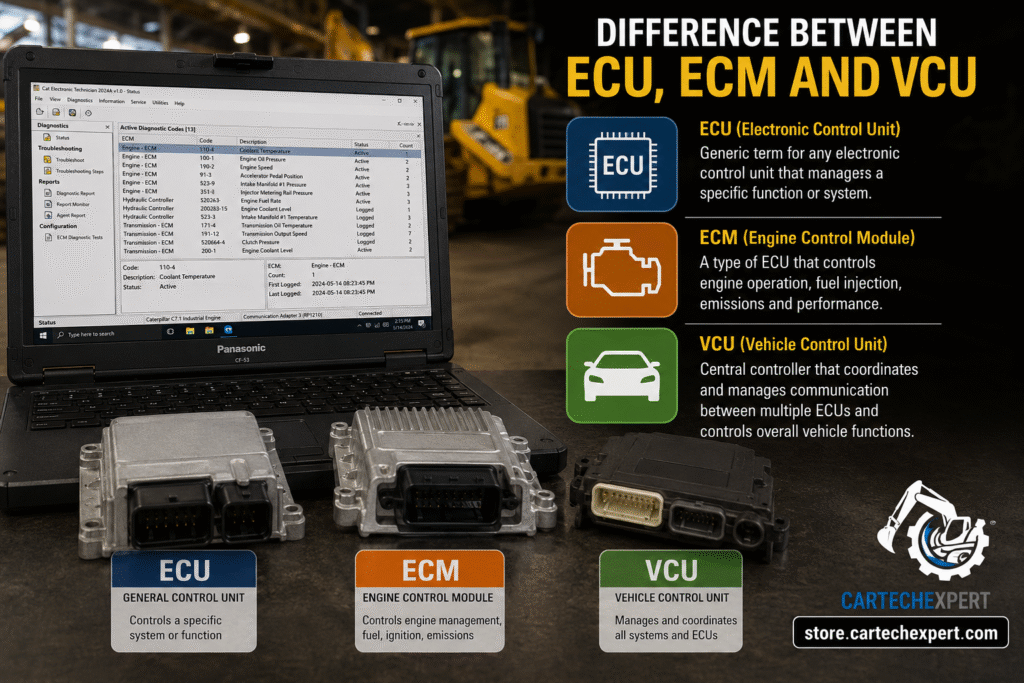
What is the difference between an ECU, ECM, and VCU?
Although these acronyms are sometimes used interchangeably, they do not always describe the same controller. Understanding their functions is essential for anyone working with OEM diagnostic software such as CAT Electronic Technician (CAT ET), Cummins INSITE, John Deere Service Advisor, Volvo Tech Tool, Komatsu Diagnostic Tool, JCB ServiceMaster, Scania SDP3, MAN CATS III, Isuzu IDSS, Hino DX2, Bobcat Service Analyzer, Kubota KOBD, Liebherr LINDIAG and many other dealer diagnostic applications.
| Controller | Full Name | Main Function |
|---|---|---|
| ECU | Electronic Control Unit | Generic term for any electronic controller on the machine. |
| ECM | Engine Control Module | Controls engine operation, fuel injection, emissions and performance. |
| VCU | Vehicle Control Unit | Coordinates multiple ECUs and manages overall machine or vehicle operation. |
ECU stands for Electronic Control Unit. It is the generic name used to describe any electronic computer that controls a specific function within a vehicle or heavy machine.
Modern heavy equipment can contain anywhere from 10 to more than 100 ECUs depending on the machine size and level of automation.
Each ECU continuously receives information from sensors, processes that information using embedded software and commands actuators to perform specific tasks.
ECM means Engine Control Module. It is a specialized ECU responsible for controlling every major engine function.
The Engine Control Module continuously receives information from dozens of sensors including:
Using these inputs, the ECM calculates the optimal operating conditions for the engine hundreds of times every second.
Whenever technicians connect CAT ET, Cummins INSITE or any OEM diagnostic software, the ECM is usually the first controller they communicate with because it contains most engine-related parameters, diagnostic trouble codes, calibrations and configuration settings.
VCU stands for Vehicle Control Unit. Unlike an ECM, which focuses only on the engine, the VCU supervises the entire machine or vehicle by coordinating communication between multiple ECUs. In many modern heavy-duty and electric platforms, the VCU acts as the central decision-making controller that integrates powertrain, hydraulics, braking, steering, operator inputs, safety systems and telematics. :contentReference[oaicite:0]{index=0}
Instead of directly controlling injectors or sensors, the VCU receives information from different control modules and decides how the complete machine should operate.
Electric construction equipment and hybrid machines rely heavily on VCUs because multiple independent controllers must work together in real time.
| Feature | ECU | ECM | VCU |
|---|---|---|---|
| Meaning | Electronic Control Unit | Engine Control Module | Vehicle Control Unit |
| Controls | Specific System | Engine Only | Entire Vehicle |
| Fuel Injection | No | Yes | Indirect |
| Hydraulic Coordination | Sometimes | No | Yes |
| Communicates with Other Controllers | Yes | Yes | Yes (Master Coordinator) |
| Stores Engine Fault Codes | Depends | Yes | Usually No |
Modern construction equipment uses communication networks such as SAE J1939 Controller Area Network (CAN). Every ECU exchanges messages with other controllers multiple times each second. Standardized terminology and communication practices are defined by SAE recommendations for heavy-duty electronic systems. :contentReference[oaicite:1]{index=1}
For example:
| Manufacturer | Typical Engine Controller | Vehicle/Master Controller |
|---|---|---|
| Caterpillar | Engine ECM | Machine ECM |
| Cummins | CM Series ECM | Vehicle Controller |
| John Deere | Engine ECU | Vehicle Control Unit |
| Volvo CE | Engine ECU | Machine ECU |
| Komatsu | Engine Controller | Machine Controller |
Many technicians replace the wrong controller because they misunderstand the role of each module. An engine performance complaint may originate from a hydraulic ECU request, while a travel limitation may be commanded by the VCU after receiving information from multiple ECUs.
Professional OEM diagnostic software allows technicians to communicate with every installed controller individually, read live data, monitor CAN communication, perform calibrations and identify which module actually generated the fault.
Yes. An Engine Control Module is a specialized type of Electronic Control Unit.
Yes. Large excavators and mining equipment may contain dozens of independent ECUs.
No. Older machines may not have a centralized VCU. Modern, hybrid and electric equipment increasingly use one to coordinate multiple controllers.
Normally the Engine Control Module (ECM), although related faults may also appear in other controllers depending on the OEM design.
The simplest way to remember the difference is this:
Understanding these controllers is essential for diagnosing modern heavy equipment efficiently. Whether using CAT ET, Cummins INSITE, Volvo Tech Tool, John Deere Service Advisor or another OEM platform, recognizing the role of each controller helps technicians identify faults faster, avoid unnecessary parts replacement and perform accurate repairs.