Physical Address
Arthur Avenue , BrookField , ILLINOIS , 60513 , United State
Physical Address
Arthur Avenue , BrookField , ILLINOIS , 60513 , United State

Last Updated: July 2026
| Quick Information | |
|---|---|
| Software Name | Detroit Diesel DiagnosticLink (DDDL) |
| Developer | Detroit Diesel / Daimler Truck |
| Category | Dealer-Level Engine Diagnostic Software |
| Supported Equipment | Detroit Diesel engines used in on-highway trucks and supported applications. |
| Main Purpose | Engine diagnostics, maintenance, troubleshooting and service support. |
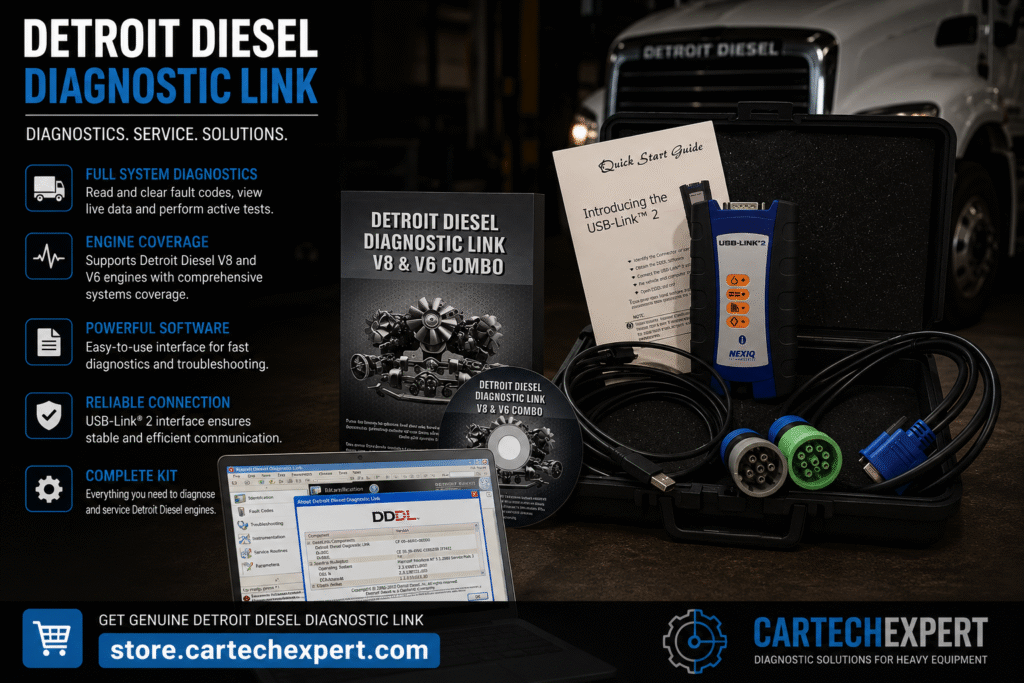
Detroit Diesel DiagnosticLink (DDDL) is the official diagnostic application used to communicate with many electronically controlled Detroit Diesel engines. It provides technicians with access to electronic control modules (ECMs) for fault diagnosis, live data monitoring and supported service procedures.
DiagnosticLink is a Windows-based service application designed for professional workshops. Using an approved communication adapter, it connects to supported Detroit Diesel electronic systems to retrieve diagnostic information and assist with maintenance.
| Engine Family | Typical Application |
|---|---|
| DD5 | Medium-duty trucks |
| DD8 | Vocational applications |
| DD13 | Heavy-duty trucks |
| DD15 | Long-haul transportation |
| DD16 | Heavy haul applications |
| Legacy Series 60 | Supported electronic platforms |
| Adapter | Notes |
|---|---|
| Nexiq USB-Link Series | Commonly used RP1210 interface. |
| Detroit Diesel DPA adapters | Compatibility depends on configuration. |
| Approved RP1210 Devices | Widely supported. |
| Feature | Availability |
|---|---|
| Read Fault Codes | Supported |
| Clear Fault Codes | Supported where applicable |
| Live Data | Supported |
| Data Logging | Supported |
| Service Tests | Depends on engine platform |
| Parameter Configuration | Depends on authorization |
Depending on the engine platform and authorization level, DiagnosticLink supports maintenance procedures, guided troubleshooting, parameter management and service-related operations.
Yes. Supported controllers provide real-time operating information.
Many workshops use approved RP1210 interfaces such as the Nexiq USB-Link family, depending on compatibility.
Available programming and configuration functions depend on engine generation, authorization and supported hardware.
Always inspect batteries, grounds and the data link before suspecting an ECM fault. Communication problems are frequently caused by power supply issues or damaged wiring rather than failed controllers.
Detroit Diesel DiagnosticLink is an essential diagnostic platform for servicing supported Detroit Diesel engines. Used with compatible communication hardware and a systematic troubleshooting process, it helps technicians improve diagnostic accuracy and reduce vehicle downtime.
