Physical Address
Arthur Avenue , BrookField , ILLINOIS , 60513 , United State
Physical Address
Arthur Avenue , BrookField , ILLINOIS , 60513 , United State

Last Updated: July 2026
| Quick Information | |
|---|---|
| Standard | SAE J1939 |
| Organization | SAE International |
| Communication Type | CAN Bus Higher-Layer Protocol |
| Typical Industries | Heavy Trucks, Construction Equipment, Agriculture, Mining, Marine, Power Generation |
| Purpose | Communication between Electronic Control Units (ECUs) |
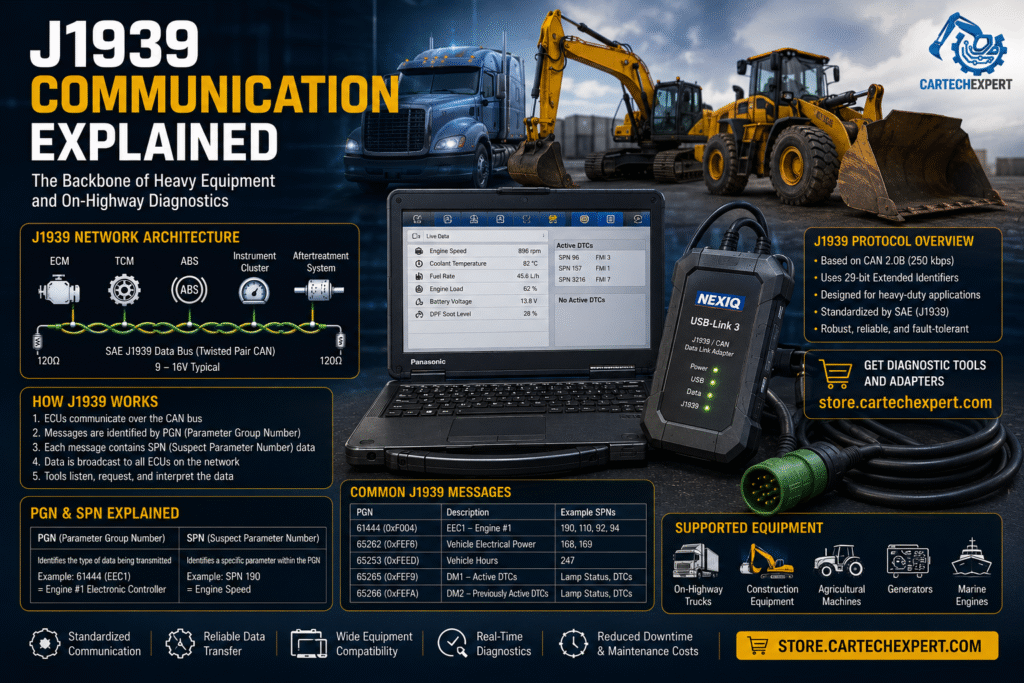
SAE J1939 is one of the most widely used communication standards in heavy-duty vehicles and off-highway equipment. It allows electronic control units (ECUs) to exchange information over a Controller Area Network (CAN) bus, enabling modern engines, transmissions, hydraulic systems, braking systems and operator displays to work together.
J1939 is a higher-layer protocol built on CAN Bus technology. Rather than simply sending electrical signals, it defines how ECUs identify themselves, exchange messages, report diagnostic information and communicate operating data.
| Component | Purpose |
|---|---|
| Engine ECU | Engine management |
| Transmission ECU | Transmission control |
| ABS Controller | Brake system |
| Hydraulic Controller | Hydraulic functions |
| Instrument Cluster | Displays machine information |
| Diagnostic Connector | Technician access |
| Item | Description |
|---|---|
| CAN High | Communication wire |
| CAN Low | Communication wire |
| 120Ω Terminators | Network stability |
| Twisted Pair Cable | Noise reduction |
Parameter Group Numbers (PGNs) identify groups of information transmitted across the network. Examples include engine speed, coolant temperature, fuel rate and many other operating parameters.
Suspect Parameter Numbers (SPNs) identify individual operating values. When combined with a Failure Mode Identifier (FMI), they form standardized diagnostic trouble codes used by technicians worldwide.
| Message | Typical Data |
|---|---|
| Engine Speed | RPM |
| Engine Coolant Temperature | Temperature |
| Fuel Rate | Fuel consumption |
| Vehicle Speed | Road speed |
| Oil Pressure | Engine lubrication |
No. CAN Bus is the physical communication layer, while SAE J1939 defines the higher-level communication rules used by many heavy-duty vehicles and machines.
Many professional interfaces such as CAT Communication Adapter III, Nexiq USB-Link, Volvo VOCOM, Cummins INLINE and other compatible interfaces can communicate with J1939 networks when used with supported software.
They help maintain signal integrity across the CAN network and reduce communication errors.
In real workshop conditions, communication failures are more often caused by damaged wiring, loose connectors or missing terminating resistors than by failed ECUs. Always verify the physical network before replacing electronic components.
Understanding SAE J1939 is essential for every heavy equipment and commercial vehicle technician. Whether diagnosing Caterpillar excavators, Volvo trucks, John Deere tractors or Cummins-powered equipment, J1939 provides the communication foundation that allows modern diagnostic software to retrieve accurate information from electronic control systems.
