Physical Address
Arthur Avenue , BrookField , ILLINOIS , 60513 , United State
Physical Address
Arthur Avenue , BrookField , ILLINOIS , 60513 , United State

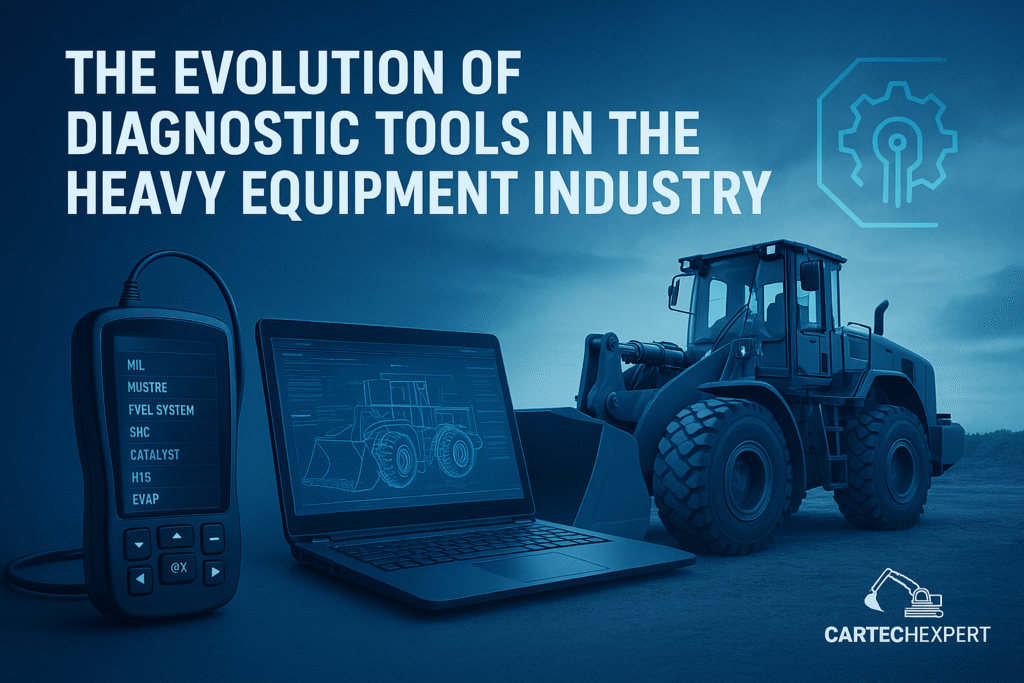
Picture this: you’re standing on a massive job site, and your excavator suddenly refuses to start. The crew is waiting, the deadline is closing in, and every passing minute is costing you money. Decades ago, you would have relied on gut feeling, a mechanic’s instinct, and trial-and-error to find the fault. Today, things look very different. With modern diagnostic tools in the heavy equipment industry, you can pinpoint issues in minutes instead of hours. That’s the power of evolution, and in this article, you’ll walk through how diagnostic tools have transformed from simple checks into advanced, AI-driven systems that keep your projects running without costly interruptions.
You know better than anyone how critical uptime is for heavy machinery. Every breakdown is not just a repair bill—it’s lost productivity, crew downtime, and missed opportunities. Diagnostic tools were developed to solve exactly that problem. They help you identify issues before they escalate, guide your maintenance, and extend the lifespan of your machines.
In the early years, you relied almost entirely on hands-on experience. Mechanics could detect engine misfires by listening closely, sense overheating by smell, or feel issues through vibrations. While impressive, this method was far from perfect. It demanded years of practice and often led to guesswork.
By the late 1980s and 1990s, manufacturers like Caterpillar and John Deere began integrating Electronic Control Units (ECUs). These small computers monitored machine functions and generated error codes when something went wrong. For the first time, machines could “communicate” with you about their internal issues.
The first tools that read ECU signals were basic handheld devices. They displayed simple codes, like “E100” or “T121,” without context. While not as advanced as today, these tools marked the beginning of a new era—replacing guesswork with data-driven diagnosis.
As technology improved, PC-based software entered the scene. Tools like Cat ET, Perkins EST, and John Deere Service ADVISOR became industry standards. By plugging your machine into a laptop, you could see live data, run calibration routines, and access fault histories.
Now, you don’t even need wires. Tools like Nexiq Blue-Link and Jaltest OHW connect wirelessly to your equipment and sync data with your smartphone or tablet. This means you can run diagnostics anywhere, anytime.
Telematics has changed how you monitor fleets. Instead of reacting to breakdowns, you can track machines remotely and get alerts before problems occur. For example, a system might warn you about a drop in hydraulic pressure before it causes a costly failure.
| Era | Tool Type | Features | Limitations |
|---|---|---|---|
| Pre-1980s | Manual methods | Sound, vibration, visual checks | Inaccurate, time-consuming |
| 1980s–1990s | Basic ECUs | Simple error codes | Limited data |
| 2000s | PC-based tools | Live data, calibration, fault codes | Wired, expensive |
| 2010s–2020s | Wireless & Telematics | Remote diagnostics, predictive maintenance | Subscription fees, data privacy issues |
AI-powered tools will not only detect problems but also suggest solutions. Imagine your diagnostic software recommending exact repair steps based on thousands of past cases.
Cloud connectivity will allow you to monitor entire fleets worldwide in real time, receiving instant alerts on any performance dips or system failures.
Technicians could use AR glasses to overlay repair instructions directly onto a machine, reducing the learning curve and cutting repair time in half.
They are devices and software designed to detect, monitor, and help repair issues in construction, mining, and agricultural machinery.
They save you time, reduce costs, and ensure your machines remain safe and productive.
Popular options include Cat ET, Perkins EST, John Deere Service ADVISOR, Jaltest OHW, and Nexiq Blue-Link.
You can expect AI-powered fault detection, predictive analytics, cloud-based monitoring, and AR-assisted repairs to dominate the future landscape.
From the days of relying on mechanical intuition to today’s AI-driven smart tools, the evolution of diagnostic tools in the heavy equipment industry is a journey of innovation and progress. As someone who depends on reliable machinery, your willingness to adapt and embrace these tools will define how efficiently and profitably you operate. Instead of fearing downtime, you now have the power to prevent it, control it, and manage it smarter than ever before.
Call-to-Action: Stay ahead of the curve—follow CARTECHEXPERT for more in-depth guides, tool comparisons, and industry insights. Equip yourself with the knowledge that turns challenges into opportunities and keeps your machines working harder for you.
Visit our CARTECHEXPERT Store to explore professional-grade OEM and universal diagnostic tools tailored for diesel and gasoline vehicles.
