Kia – Design Revolution & Smart Automotive Manufacturing
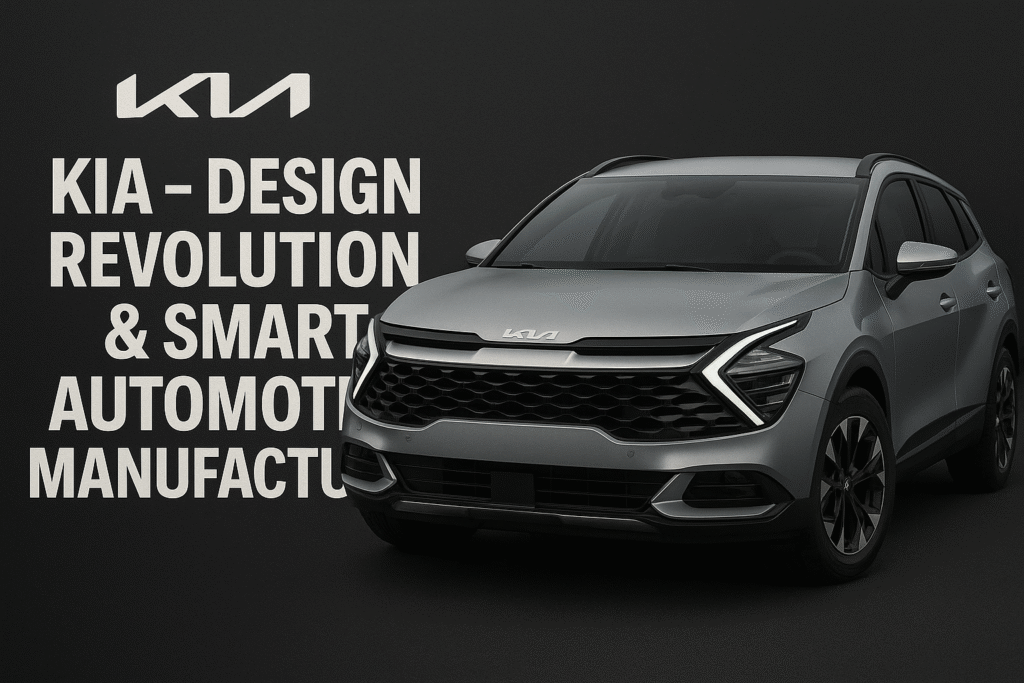
Table of Contents
Introduction — When “Cheap Transport” Becomes a Design Statement
A crossover rolls into the workshop for its first scheduled service. The technician walks around it almost out of habit, but pauses for a moment at the surfacing of the body sides, the lighting signatures, and the way the interior layout makes sense from a usability standpoint. A decade earlier, this badge would have been associated almost exclusively with “budget choice.” Now it arrives with LED lighting, a sleek dashboard, neatly integrated ADAS sensors, and a fully digital cluster. That badge is Kia.
For engineers, technicians, and fleet managers, Kia’s transformation is not merely cosmetic. Beneath the distinctive exteriors lies a portfolio of refined powertrains, shared EV architectures, improved manufacturing quality, and software-rich control systems. Kia’s evolution is a case study in how an automaker can pivot from price-led competition to design-led value—without losing touch with manufacturability and maintainability.
This article explores “Kia – Design Revolution & Smart Automotive Manufacturing” from a technical and practical perspective. It covers brand heritage, the design revolution that reshaped Kia’s identity, the underlying engineering and platform strategies, powertrain evolution toward hybrid and electric vehicles, smart manufacturing systems, materials choices, maintenance implications, and occupational safety. It concludes with data tables, FAQs, and references to related articles on cartechexpert.com and tooling and training resources on store.cartechexpert.com.
Definition: Kia – Design Revolution & Smart Automotive Manufacturing
“Kia – Design Revolution & Smart Automotive Manufacturing” describes the combined impact of two major strategic shifts:
- A deliberate, long-term reinvention of Kia’s visual and experiential identity through design—exteriors, interiors, UX, and brand language.
- Parallel modernization of engineering and manufacturing: shared platforms, modular powertrains, higher automation, digitalized factories, and quality-focused process control.
Together, these shifts moved Kia from low-cost anonymity to a recognizable global brand associated with strong styling, competitive technology, and increasingly sophisticated dynamics. For the technical audience, it means Kia vehicles now arrive in workshops with complex electronics, EV drivetrains, refined ICE engines, and tightly packaged chassis—demanding professional diagnostic and repair approaches.
Heritage & Brand Transformation
Kia’s roots reach back to mid-20th-century Korea, initially focusing on bicycles and light vehicles before moving into passenger cars. For much of its early automotive history, Kia was seen as a supplier of affordable, functional vehicles—often sharing technology with partner brands, and sold primarily on price and warranty length rather than design or dynamic sophistication.
Key phases in Kia’s evolution:
- Early expansion: simple platforms, limited electronic content, basic interior and exterior styling.
- Globalization phase: broader export programs, joint platform development with related manufacturers, and the first attempts at distinctive styling.
- Design-led transformation: investment in international design centers, recruitment of high-profile designers, and the adoption of consistent design signatures across the range.
- Electrification & smart manufacturing era: entry into serious hybrid and EV markets, adoption of shared EV platforms (like E-GMP), and modernization of global plants using Industry 4.0 principles.
Today, Kia’s lineup consists of vehicles that can be meaningfully compared to established Japanese, American, and European competitors on design, comfort, technology, and—important for this audience—engineering content and service complexity.
Design Revolution: From Anonymous to Recognizable
The most visible part of Kia’s transformation is the design revolution. Exterior signatures, interior architecture, and UX design all changed to emphasize clarity, tension, and functionality rather than generic shapes. For engineers and technicians, this shift has practical implications in areas like serviceability, sensor placement, and component access.
Exterior Design & Lighting
Modern Kia vehicles use distinctive front-end graphics, sculpted body sides, and integrated aero features. Engineering considerations include:
- Complex lighting systems (LED DRLs, projector or matrix headlights) with integrated thermal and electronic controls.
- Aero-optimized bumpers and underbody panels that alter airflow and cooling while affecting access to components.
- Packaged ADAS sensors—radar modules, cameras, ultrasonic sensors—behind design elements that must maintain visibility and thermal performance.
Interior Architecture & UX
Kia’s interiors have moved from purely functional to design-led, with:
- Wide-screen clusters that combine instrument panel and infotainment in a single housing.
- Multi-layered dashboards and center consoles, integrating HVAC, media, and drive mode controls.
- Improved seating ergonomics and material quality, including soft-touch surfaces and modular trim panels.
For service professionals, this means increased emphasis on:
- Electronics diagnostics for clusters, head units, and networked control modules.
- Careful removal and replacement of trim to access wiring, sensors, and HVAC components without damaging aesthetic surfaces.
Engineering Philosophy & Platform Strategy
Kia’s engineering philosophy today mirrors that of a modern, globally competitive automaker: modular platforms, efficiency-focused powertrains, and shared technologies with related brands. The goal is to deliver vehicles that meet region-specific requirements while sharing enough hardware and software to maintain scale advantages.
Modular Platforms
Kia’s platforms are designed to:
- Accommodate different body styles—sedans, hatchbacks, SUVs, MPVs.
- Support multiple powertrain types: pure ICE, mild hybrid, full hybrid, plug-in hybrid, and EV (or EV-adapted variants).
- Standardize key interfaces such as suspension mounting points, steering components, and front-end structural modules.
This modular strategy benefits engineers and technicians by:
- Providing predictable component layouts across different models.
- Allowing reuse of diagnostic workflows across related vehicles.
- Supporting parts compatibility, which is useful for fleet maintenance and inventory management.
Systems Integration
Kia integrates mechanical, electrical, and software systems to:
- Coordinate engine, transmission, and traction motor behavior.
- Align ADAS functions with braking, steering, and power management.
- Support OTA (over-the-air) updates in newer models to refine calibrations post-sale.
Powertrains: ICE, Hybrid, and Electrification
Kia’s powertrain mix reflects industry-wide trends: legacy internal combustion engines, increasingly sophisticated hybrids, and growing EV offerings. Understanding each type’s engineering objectives and service implications is critical for workshop professionals.
Internal Combustion Engines (ICE)
Modern Kia ICE offerings often share development with related brands and include:
- Small to mid-size gasoline engines with direct injection and turbocharging for efficiency and power density.
- Variable valve timing and, in some cases, variable valve duration technologies.
- Integrated exhaust manifolds and advanced EGR strategies for emissions control.
Service considerations:
- Oil quality and change interval discipline to protect turbochargers, timing chains/belts, and hydraulic actuators.
- Injection system cleanliness and high-pressure pump integrity.
- Cooling system performance in compact engine bays where thermal loading is high.
Hybrid & Plug-In Hybrid Systems
Kia’s hybrids use a combination of:
- A gasoline engine optimized for efficiency (often Atkinson cycle).
- An electric traction motor integrated into the transmission or drivetrain.
- An inverter and DC-DC converter module.
- A battery pack sized for energy recovery and short-period electric drive.
Workshop focus:
- High-voltage (HV) safety procedures and isolation checks.
- Service of complex cooling circuits shared between engine, electronics, and battery.
- Regenerative braking calibration and mechanical brake inspection, since friction brakes may show different wear patterns due to regen usage.
Transition to EVs
Kia’s EV strategy shares much of its underpinnings with Hyundai through the E-GMP platform, while also offering EV versions of existing models. EV-specific engineering aims at:
- Providing usable range and high torque in compact packages.
- Fast-charging capability and robust thermal control to protect battery life.
- Integration of cabin HVAC with battery temperature management, especially in extreme climates.
EV Architecture, E-GMP & Software Integration
Kia’s more advanced EVs are built on E-GMP, a dedicated EV architecture designed for scalability and efficiency. For technical professionals, key elements include:
Battery & High-Voltage System
- Flat, underfloor battery pack with multiple modules monitored by a centralized BMS.
- Potential 800 V architecture in some models, enabling very fast DC charging under appropriate conditions.
- Robust HV cabling and contactors, designed with redundant safety mechanisms and isolation monitoring.
Drive Units & Thermal Management
- Integrated electric drive units (EDUs) combining motor, reduction gear, and inverter.
- Shared or dedicated cooling circuits, controlled by electric pumps and valves, coordinating with cabin HVAC demands.
- Thermal strategies that precondition batteries for optimal charging in cold or hot environments.
Software & Connectivity
- Drive modes and traction control tuned via software, altering pedal maps, regen intensity, and torque delivery.
- Telematics and connectivity used for software updates, remote diagnostics, and in some markets, vehicle-to-grid or vehicle-to-load functionality.
- Integrated ADAS features (lane following, adaptive cruise, collision avoidance) tightly connected with braking and steering control units.
For workshops:
- OEM diagnostic tools are essential to read HV system status, BMS data, and perform software updates.
- Any HV repair must follow strict isolation, verification, and post-service testing procedures.
Smart Automotive Manufacturing & Global Plants
Kia’s shift to premium perception is underpinned by smarter factories: more automation, better process control, and higher-quality materials applied consistently across global plants.
Automation & Industry 4.0 Techniques
- Robotic welding and adhesive application in body shops for consistent joint quality.
- Automated sealant and corrosion-protection processes on underbodies and cavities.
- Use of digital twins and MES data to track tool wear, torque trends, and process deviations.
Quality Management
- Standardized torqueing sequences recorded at each assembly station.
- End-of-line testing for electrical systems, ADAS sensor alignment, and NVH benchmarks.
- Corrective feedback loops from warranty and field data back into process engineering.
For technicians, this manufacturing maturity translates into:
- Generally consistent assembly quality and predictable disassembly/assembly behavior.
- Parts that are designed for modular replacement, with detailed service manuals and torque specifications.
Materials, Durability & Corrosion Management
Kia’s move toward a more premium positioning required upgrades in material quality and corrosion protection. While regional variations exist, trends include:
- Increased use of high-strength steel and hot-stamped components for safety.
- Improved galvanisation and e-coat processes on body-in-white.
- Greater use of structural adhesives and foam fillers for stiffness and NVH control.
- Aero shields and underbody panels that also protect from debris and salt to some extent.
Technician tasks in this context:
- Monitor common rust-prone regions (subframes, wheel arches, pinch welds) especially in high-salt markets.
- Use factory-approved materials when repairing structural components or reapplying underbody coatings.
- Ensure drains and cavities remain clear after body repairs, to avoid new water traps.
Maintenance Strategies & Workshop Best Practices
Servicing modern Kia vehicles requires a structured approach that takes both mechanical and electronic systems into account. Below are recommended best practices for professional workshops.
1. Diagnostic Workflow
- Always begin with a full system scan: engine, transmission, ABS/ESC, body electronics, ADAS modules, and HV systems where present.
- Record DTCs and freeze-frame data before clearing anything, for root-cause analysis and warranty documentation.
- Use live-data and, when possible, data logging to capture intermittent issues in real driving conditions.
2. ICE & Turbo Engines
- Verify oil type and change intervals—turbocharged engines are sensitive to oil breakdown.
- Track timing chain/belt intervals; early symptoms of chain stretch (noise, correlation codes) should be addressed quickly.
- Inspect intercooler, piping, and boost control hardware when addressing power loss or detonation complaints.
3. Hybrid Systems
- Respect HV boundaries: isolate and lock out the system when working on orange HV cables or components.
- Maintain cooling circuits for inverters, motors, and batteries—check coolant quality and flow.
- Calibrate and test regenerative braking; verify brake pedal feel and general braking performance after any related work.
4. EV Maintenance
- Perform HV isolation checks and verify pack contactor behavior before deep diagnosis.
- Inspect HV cabling and connectors for impact or corrosion damage, particularly after accidents or off-road use.
- Monitor battery SOH using OEM tools; report degradation trends clearly to customers and fleet managers.
- Check tires and suspension more frequently in high-torque EVs, where wear rates can exceed ICE equivalents.
5. ADAS & Calibration
- After replacing windshields, bumpers, or suspension components, perform the required ADAS calibrations.
- Use approved calibration equipment and follow static/dynamic procedures as per Kia’s manuals.
- Explain to customers that ADAS performance depends on correct calibration and sensor cleanliness.
Occupational Safety & Service Protocols
Kia’s modern portfolio brings high-voltage systems, advanced airbags, and dense sensor suites into workshops. Safety practices must keep pace.
- High-voltage training: ensure technicians working on hybrids and EVs are certified and understand isolation, verification, and emergency procedures.
- PPE: insulated gloves, HV-rated tools, appropriate eye protection, and arc-rated clothing where necessary.
- Safe lifting and support: observe official lifting points and battery pack support guidelines, especially on EVs where underfloor packs change weight distribution.
- Fire safety: have suitable extinguishers and protocols for dealing with potential battery thermal events, including quarantine areas for damaged packs.
- Airbag & pyrotechnic device handling: follow disconnect and wait procedures strictly to avoid accidental deployment.
Illustrative Tables & Comparative Metrics
Table 1 — Powertrain Types & Workshop Focus for Kia Vehicles
| Powertrain Type |
Main Benefits |
Primary Service Concerns |
Key Tools/Skills |
| ICE (NA/Turbo) |
Lower upfront cost, established tech |
Oil quality, timing components, fuel injection |
Standard diagnostics, mechanical skills |
| Hybrid |
Lower fuel consumption, smooth operation |
HV battery, inverter cooling, regen & friction brakes |
HV safety, OEM diagnostic software |
| BEV (E-GMP and variants) |
Zero tailpipe emissions, high torque |
Battery SOH, HV safety, thermal control |
HV certification, BMS diagnostics, isolation testers |
Table 2 — Workshop Priority Checklist for Modern Kia Vehicles
| Task |
Priority |
Applies To |
Notes |
| Full system scan & data capture |
High |
All modern Kia |
Baseline for accurate diagnosis & warranty records |
| HV isolation & lockout |
High |
Hybrid & EV |
Mandatory before any HV work |
| Cooling system inspection |
High |
Turbo ICE, hybrid & EV |
Multiple cooling circuits; check levels & flow |
| Brake & tire evaluation |
Medium–High |
All, especially EV |
EV torque & regen alter wear patterns |
| ADAS calibration check |
High after relevant repairs |
Vehicles with ADAS |
Required after glass, bumper, or suspension work |
FAQ Section
1. What makes Kia’s recent products different from its older models from an engineering perspective?
Modern Kia vehicles use more advanced platforms, improved materials, better NVH control, and a wider range of powertrains—especially hybrids and EVs. Electrification and ADAS integration mean more complex electrical architectures and software-driven behavior compared with the simpler, largely mechanical setups of older models.
2. Are Kia’s EVs difficult to service compared with other brands?
Kia’s EVs follow similar principles to other mainstream EVs: battery, inverter, motor, and reduction gear with high-voltage safety requirements. With proper training and OEM diagnostic tools, servicing is straightforward, but technicians must respect HV protocols and understand the specific architecture (e.g., E-GMP) used.
3. How does Kia’s design focus affect workshop operations?
More complex exterior and interior designs can mean increased care is needed when removing trim or accessing components. ADAS sensors often sit behind stylized grilles and fascias, requiring correct reinstallation and calibration. However, service manuals are structured to reflect these complexities, and modular replacement is common.
4. Do Kia hybrids require different maintenance schedules than their conventional ICE counterparts?
Yes. While engine oil and coolant change intervals may be similar, hybrids require additional attention to HV components, cooling circuits for inverters and batteries, and brake system inspections due to regenerative braking patterns. Always follow the hybrid-specific service schedules provided by the manufacturer.
Suggested Past Article & Further Reading
To situate Kia’s design revolution and smart manufacturing in a broader industry context, consider reviewing earlier articles in this series:
You can access these articles and more detailed technical content at our main site: cartechexpert.com
For workshop tools, diagnostic templates, EV safety training materials, and SOP packages, visit our store: store.cartechexpert.com
Conclusion & Call to Action
Kia’s trajectory—from budget brand to design-focused, technology-rich manufacturer—is driven by strategic design decisions and smart manufacturing investments. For engineers and technicians, the key message is that modern Kia vehicles deserve the same disciplined, data-driven, and safety-aware service approach applied to any major global brand.
Operationally:
- Identify the platform and powertrain correctly—ICE, hybrid, or EV—before planning diagnostics.
- Use OEM-compatible tools and current service data, including ADAS calibration procedures.
- Implement rigorous HV safety programs for hybrid and EV models.
- Track software versions and update opportunities, especially where drivability or range complaints arise.
If this article supports your technical work or fleet planning, share it within your organization and integrate the checklists and tables into your workshop procedures. For deeper training, EV/ADAS modules, and structured diagnostic frameworks aligned with Kia and other OEMs, explore our resources at cartechexpert.com and store.cartechexpert.com.
Thank you for reading.

