Physical Address
Arthur Avenue , BrookField , ILLINOIS , 60513 , United State
Physical Address
Arthur Avenue , BrookField , ILLINOIS , 60513 , United State

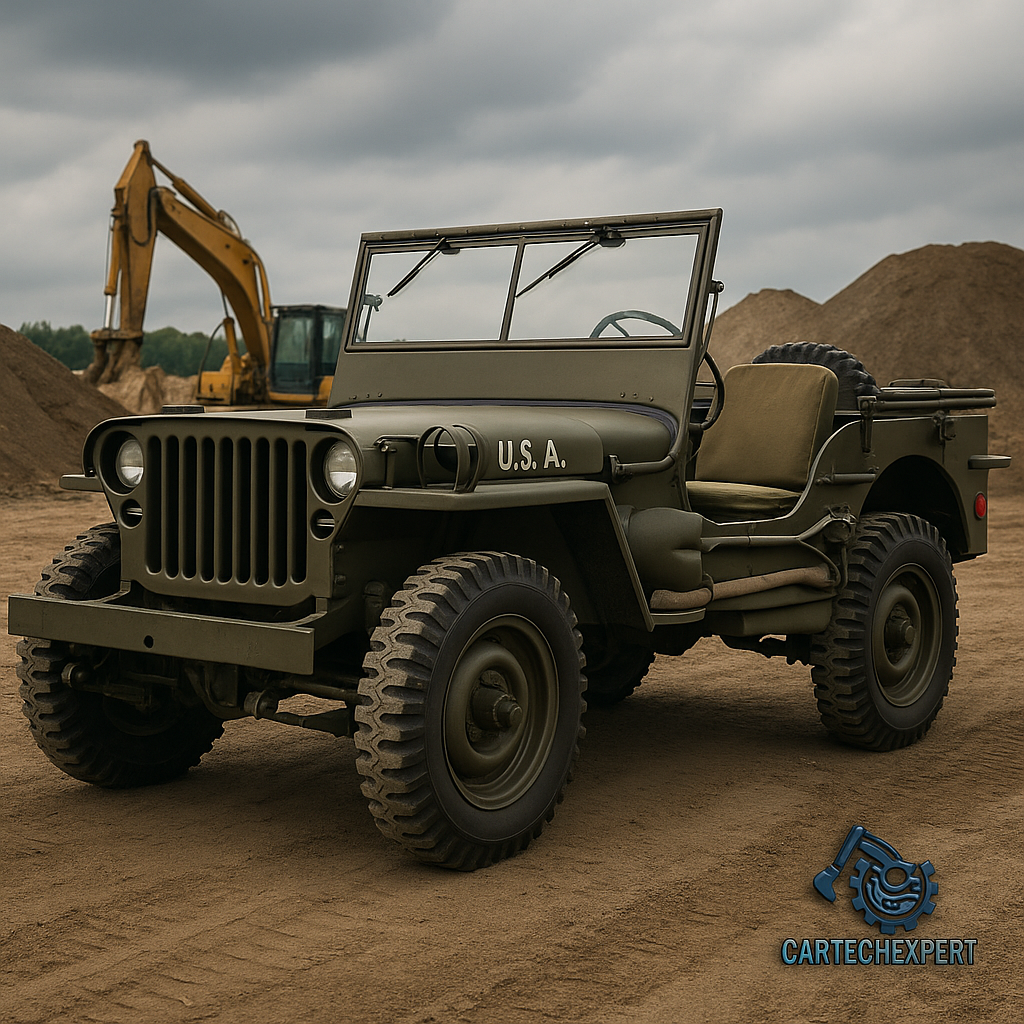
Before Jeep became a global symbol of adventure and civilian off-road culture, it was something far more uncompromising: a battlefield tool. A compact, simple, rugged military truck built not for comfort—but for survival.
For engineers, technicians, and mechanics, the early Jeep is a masterclass in wartime engineering efficiency. Every bolt, every panel, every component was designed for rapid field repair, reliability under fire, and mobility across brutal terrain. These early trucks carried soldiers, hauled weapons, rescued the wounded, and shaped the blueprint for all modern 4×4 vehicles.
“Jeep – Early Military Trucks Before SUVs” refers to the WWII-origin vehicles developed for the U.S. Army, including the Willys MB and Ford GPW, and their early post-war successors. These trucks formed the foundation of modern 4×4 engineering and influenced nearly every off-road utility vehicle that followed.
They were used for:
In 1940, as tensions escalated globally, the U.S. Army requested a light, fast, rugged 4×4 military truck capable of operating in extreme battlefield conditions. The requirements included:
The final standardized military Jeep became the Willys MB and its Ford-built twin, the GPW.
The most iconic WWII Jeep—lightweight, strong, and designed for rapid field maintenance. It featured:
Mechanically identical to the MB but built by Ford under contract. Ford’s production improvements allowed massive wartime output.
Used in the Korean War, the M38 featured:
Early military Jeep platforms also inspired cargo-bed and communications utility truck variations.
One of the Jeep’s greatest engineering triumphs was its ability to be repaired anywhere—with minimal tools and no specialized equipment.
After WWII, Jeep introduced the CJ (Civilian Jeep) models, which evolved into early utility pickups and farm trucks:
Jeep-built early civilian trucks included:
These models expanded Jeep’s reach into construction, agriculture, emergency services, and forestry.
Early military Jeeps had no electronic safety systems. Operators relied entirely on vehicle control and terrain awareness.
Note: These vehicles require experienced operators due to their vintage handling and braking characteristics.
| Engine | Displacement | Output | Era |
|---|---|---|---|
| Go Devil | 2.2L | 60 hp | WWII |
| Hurricane | 2.2L OHV | 72 hp | CJ Series |
| F-Head | 2.4L | 75 hp | 1950s |
| Component | Type | Benefit |
|---|---|---|
| Transfer Case | 2-Speed Dana | High/low off-road control |
| Axles | Solid Dana 25/27 | Durability under load |
| Suspension | Leaf Springs | Simple heavy-duty reliability |
Extremely. Their simplicity made them ideal for battlefield repairs and harsh terrain.
Yes. Parts availability is strong, especially for MB, GPW, and CJ models.
Its 4×4 capability, lightweight design, and extraordinary mechanical simplicity.
No. They lack modern braking, stability, and crash protection systems, requiring skilled operation.
“Early Jeep military trucks were rugged 4×4 vehicles used extensively during WWII and the Korean War.”
Jeep’s early military trucks are engineering icons—symbols of ruggedness, reliability, and mechanical purity. Before the SUV era, Jeep’s identity was forged in warzones, deserts, jungles, and frozen battlefields. These trucks shaped global 4×4 history and remain some of the most influential utility vehicles ever built.
To explore more heavy-duty engineering content, visit:
cartechexpert.com
For professional tools, workshop equipment, and diagnostics, shop at:
store.cartechexpert.com
